Here is the sentence most stamp websites won’t lead with: the overwhelming majority of stamps — including genuinely old ones — are worth pennies. Not because collecting is dead, but because of simple arithmetic. Understanding that arithmetic is the fastest way to find the exceptions, and the exceptions are real.
Old does not mean valuable
Two examples from opposite ends of the spectrum make the whole point.
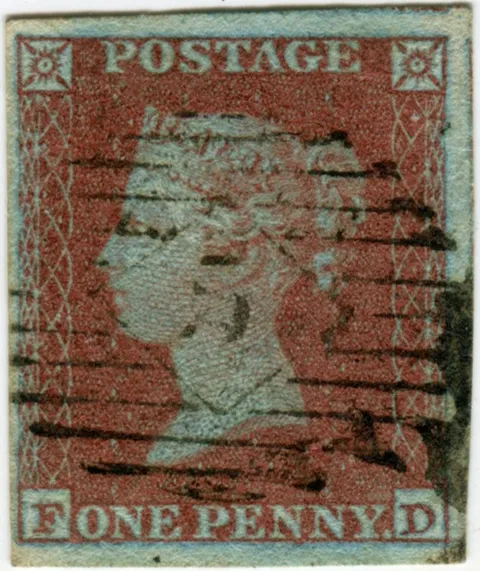
Great Britain’s Penny Red was printed from 1841 to 1879 — about 21 billion copies. It is over 145 years old, engraved, bearing Queen Victoria’s portrait… and a typical used example trades for 10p to 30p, because enormous numbers survive. Age had a century and a half to work its magic, and the price is still pocket change.
Meanwhile, the United States printed 4.2 billion of the 1932 2¢ Washington Bicentennial stamp. Dealer retail today: about $0.40. That one stamp is what most inherited American albums are mostly made of.
Now the contrast: the 1930 Graf Zeppelin airmail set. One million of each value were printed — but the set cost $4.55 in the first year of the Great Depression, almost nobody bought it, and 93% of the printing was destroyed when sales ended. Barely 227,000 stamps survived into collections. A complete set retails around $1,775 today.
Same era. The difference isn’t age — it’s how many survived versus how many people want one.
Catalog value is not sale value
If you look your stamp up in a catalog and see a price, read it as a ceiling, not a promise. The American Philatelic Society’s own estate guidance puts it bluntly: catalog value “is almost NEVER the appraisal valuation,” and collections generally sell for less than catalog. The UK auction house Warwick & Warwick says the same thing from the trade side: published values assume perfect examples, and “even most dealers discount their prices heavily from the values they display.”
Three multipliers decide where your stamp really lands inside (or below) that catalog range:
- Condition beats everything. A stamp with its full original gum, never mounted with a hinge, is worth far more than the same stamp hinged — and a faded, creased, or thinned example can be nearly worthless regardless of rarity.
- Margins and centring. On early imperforate classics, four wide, even margins can multiply the price; a design cut into by scissors sits at the bottom of every range.
- Cancellation. A clear, light postmark usually beats a heavy smudge; some scarce cancellation types are worth more than the stamp itself.
Where the real value hides
Almost all the money in philately concentrates in a few narrow places:
- Genuine rarities — stamps where only dozens or hundreds survive.
- Errors — inverted centers, missing colors, wrong papers. Printing mistakes that escaped quality control become the most valuable stamps of all.
- Condition rarities — common-ish stamps that almost never survive in top grade.
- Covers and postal history — envelopes that document a rate, a route, or a first flight can be worth more than the stamps on them. (Don’t soak stamps off old envelopes — you can destroy the valuable part.)
Modern commemorative sheets, sadly, are almost never in this group: they were printed by the million for collectors, everyone saved them, and they routinely trade at or below face value.
The same math, country by country
The survivor arithmetic repeats everywhere you look. In Great Britain, the everyday Penny Lilac of 1881 was printed in the tens of billions and retails for 20p to £1.60 — while the £5 Orange of 1882, with only a few thousand believed to survive, trades in the thousands of pounds. In the United States, an 1893 2¢ Columbian is over 130 years old and costs less than $30 because nearly 1.5 billion were issued; its $5 sibling from the very same series, with only around 22,000–27,000 sold, retails in the thousands of dollars. Same designs, same eras, same albums — the printing numbers decide everything.
We keep honest, source-linked price tables for both countries in our US stamp values and British stamp values guides, and deep-dive pages for the famous names people actually find in albums, from the Penny Black to the Inverted Jenny.
How to check yours without becoming an expert
The traditional route is a specialist catalog, a perforation gauge, and patience. The shortcut: photograph the stamp and let identification software do the first pass — country, year, denomination, catalog number, and an honest estimated range — then, if the answer is exciting, confirm with a qualified dealer or expertising service before you buy or sell anything. That last step matters at any price level worth caring about: a real find deserves a real certificate.
The good news in all this honesty: because most stamps are common, the valuable ones are findable. Every album has a floor of pennies — and, occasionally, one stamp that pays for the whole box.
The genuine article
So you can compare against the real thing — these are genuine, public-domain reference images, not illustrations: