
Estimated ranges from catalog & auction data — condition-dependent, not a professional appraisal. Treat every figure below as a starting point and confirm with a qualified expert before buying or selling.
Inverted Jenny value: what it's worth
Value depends heavily on condition, so the figures below are given as ranges by tier rather than a single price. Extremely rare — only 100 ever existed.
| Condition | Estimated value |
|---|---|
| Single, lower grade / with faults Indicative range for faulty or lower-grade singles; even compromised examples are six figures — the severely damaged 'locket copy' (position 9) made $164,500 at Stack's Bowers in May 2015. Exact price is grade- and position-specific — get a current auction estimate. | $150,000 – $350,000 |
| Single, sound, average to fine Mid-market singles. A 2016 Siegel sale of a single realized ~$1,351,250 all-in, showing how condition pushes into seven figures. | $300,000 – $900,000 |
| Single, finest known (graded XF-Superb 95, never hinged) Position 49, graded 95, sold for $2,006,000 (incl. premium) at Siegel, Nov 2023 — a record for any single US stamp. | $1,500,000 – $2,006,000 |
| Multiples / plate-number block of four The plate-number block of four sold for $2,970,000 (Siegel, late Oct 2005, to Bill Gross); the same unique plate block later made $4,860,000 incl. premium at Sotheby's Weitzman sale, 8 June 2021. Blocks and plate blocks trade well above singles. | $2,700,000 – $5,000,000 |
Values last checked: July 4, 2026.
Record / notable sale $2,006,000 (hammer $1,700,000 plus 18% buyer's premium) — 8 November 2023, Robert A. Siegel Auction Galleries (position 49, graded Mint NH XF-Superb 95).
Rarity & how many exist
Extremely rare — only 100 ever existed.
- Print run: One pane of 100 stamps with the inverted center; no others known to exist
- Surviving examples: 100 (the single discovered sheet) — a few are lost or destroyed; the rest are tracked in a published census
Catalog numbers
- Scott: Scott C3a
- Stanley Gibbons: n/a (US issue; Scott is the standard catalogue)
- Colnect: Colnect: United States 1918 Curtiss JN-4 (inverted)
History
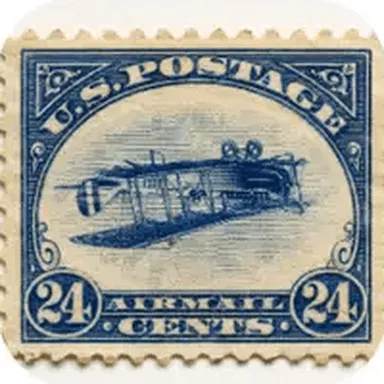
The stamp was printed in two passes (carmine frame, blue vignette) and on one sheet the vignette was inverted, showing the 'Jenny' biplane flying upside down. Collector William T. Robey bought that sheet at a Washington, D.C. post office on 14 May 1918 for face value and quickly sold it to dealer Eugene Klein for $15,000; Klein sold it on to Colonel Edward H. R. Green for $20,000, after which the sheet was broken up. Individual positions and small blocks have been traded ever since, and the Smithsonian's National Postal Museum holds several examples. With only 100 in existence, genuine examples are six- and seven-figure rarities.
How to tell if yours is the valuable one
- Be extremely cautious: counterfeits, fakes and printed reproductions vastly outnumber the 100 genuine stamps. Assume any unverified 'Inverted Jenny' is not genuine until expertised.
- Every genuine stamp's position in the original sheet is recorded in the published Siegel census; a genuine example should match a known position and provenance.
- Do not confuse it with the 2013 USPS commemorative reissue (a modern $2 souvenir stamp deliberately printed inverted) — that is a current postage stamp, not the 1918 rarity.
- Require a certificate from a recognised authority (e.g. The Philatelic Foundation or Professional Stamp Experts); top examples are graded (the record stamp scored 95/100).
- Check colours (carmine-rose frame, blue inverted vignette), perforations and gum against reference images; genuine examples are well documented.
Quick identification tips
- Genuine 1918 examples are gummed or (for some museum/used pieces) without gum, on 1918 paper; modern reissues are clearly marked and common.
- Provenance is everything: a genuine stamp comes with a paper trail back through the census to the original 1918 sheet.
Related stamps
- Penny Black value — Common — tens of millions issued, over a million survive.
- Blue Mauritius value — Among the rarest stamps in the world — only ~26-27 known.
See also our guide to what your stamp is worth and how stamp values really work.
Sources
Every figure on this page traces to a published reference or recorded sale:
- Inverted Jenny — Wikipedia
- Inverted Jenny — Smithsonian National Postal Museum
- Inverted Jenny census & records — Robert A. Siegel Auction Galleries
- Why a single 'Inverted Jenny' stamp sold for $2 million at auction — NPR
- A Rare 'Inverted Jenny' Stamp Sold for a Record-Breaking $2 Million — Artnet News
- Jenny Invert 'locket copy' sold ($164,500, 2015) — Linn's Stamp News
- The Inverted Jenny plate block ($4.86M, 2021) — Sotheby's