Estimated ranges from catalog & auction data — condition-dependent, not a professional appraisal. Treat every figure below as a starting point and confirm with a qualified expert before buying or selling.
Blue Mauritius value: what it's worth
Value depends heavily on condition, so the figures below are given as ranges by tier rather than a single price. Among the rarest stamps in the world — only ~26-27 known.
| Condition | Estimated value |
|---|---|
| Single used example (one penny or two pence) Indicative six-to-seven-figure range based on historic sales (a used one penny made about US$1.07 million at David Feldman's 1993 sales); price varies enormously by condition, margins and provenance. Each is effectively unique — any sale is by negotiation or major auction. Treat as estimate only. | $500,000 – $2,000,000 |
| Single unused / mint two pence ('Blue Mauritius') An unused two pence sold for about US$1,150,000 (SFr 1,725,000) at David Feldman's 1993 Kanai sale (Feldman's own summary cites CHF 1.61 million). In 2002 the 'Mauritius blue' was estimated at around £2 million. | $1,000,000 – $2,000,000 |
| The 'Bordeaux cover' (both 1d and 2d on one envelope) Realised SFr 5,750,000 (about US$4 million / £2.64 million at the time); SFr 6,175,000 including all commissions. David Feldman, Zurich, 3 Nov 1993 — then a world record for any philatelic item. | CHF 5,750,000 – CHF 6,175,000 |
| The 'Ball cover' (1d on Lady Gomm's 1847 ball invitation) €8.1 million hammer, €10,027,800 with premium (≈ US$11-12 million), Christoph Gärtner, 26 June 2021 — the all-time record price for any philatelic item. | €8,100,000 – €10,027,800 |
Values last checked: July 4, 2026.
Record / notable sale The 1d 'Ball cover': €8.1 million hammer, €10,027,800 with premium — the all-time record for any philatelic item. Earlier records: the 'Bordeaux cover' (both values) SFr 5,750,000 / SFr 6,175,000 incl. commissions (~$4 million, 1993); Barnard's original 'Post Office' copper printing plate about €1,300,000 (2016). — 26 June 2021 (Ball cover); 3 November 1993 (Bordeaux cover); 2016 (printing plate), Christoph Gärtner, Ludwigsburg (2021); David Feldman SA, Zurich (1993, 2016).
Rarity & how many exist
Among the rarest stamps in the world — only ~26-27 known.
- Print run: 500 of each value printed from a single plate (1,000 stamps total)
- Surviving examples: About 26-27 examples known in total — roughly 15 of the one penny (incl. ~2 unused) and ~12 of the two pence (incl. ~4 unused); Wikipedia cites 27 total (as of 1981)
Catalog numbers
- Scott: Scott 1 (1d) and 2 (2d)
- Stanley Gibbons: Stanley Gibbons 1-2 (later wear states catalogued through SG 3-25 for the 'Post Paid' issues)
- Colnect: Colnect: Mauritius 1847 'Post Office' 1d / 2d
History
Mauritius issued these on 21 September 1847, the first British colony to produce its own stamps. They were engraved by Joseph Osmond Barnard, who carried his initials 'JB' on the design, and they read 'POST OFFICE' rather than the 'POST PAID' used on later issues — long thought an error but now generally regarded as a deliberate, legitimate inscription. Only 500 of each value were printed from a single plate, and roughly 26-27 survive today, making genuine examples museum-grade rarities. The 'Bordeaux cover,' an envelope bearing both values, set a world record for any philatelic item when it sold in 1993; that record now belongs to the 1d 'Ball cover' — an invitation to Lady Gomm's 1847 fancy-dress ball — which made €10 million with premium in June 2021.
How to tell if yours is the valuable one
- Genuine examples are vanishingly rare (~26-27 known) and almost all are accounted for in collections and museums; assume any unverified 'Post Office' Mauritius is a forgery, facsimile or the common later 'Post Paid' issue until proven otherwise.
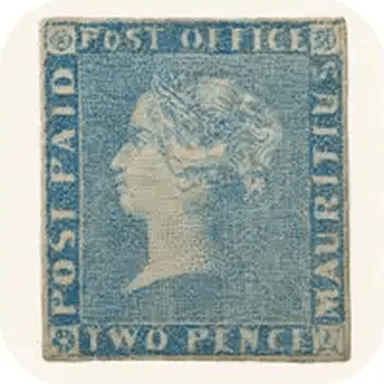
- The defining detail is the words 'POST OFFICE' at left; the far more common follow-on issue reads 'POST PAID.' Confirm the inscription first.
- Look for engraver Joseph Barnard's 'JB' initials and the specific engraving characteristics; specialists compare against the documented plate and known examples.
- Provenance and a certificate from a top expert body are essential — the surviving stamps have well-documented histories, so a credible example should trace to a known specimen.
- Numerous facsimiles and reproductions exist (including period forgeries); never rely on appearance alone for an item purported to be this rare.
Quick identification tips
- 'POST OFFICE' = the 1847 rarity. 'POST PAID' = the later, far more common Mauritius issue.
- Two pence deep blue = the 'Blue Mauritius'; one penny orange-red = the 'Red Mauritius.' Both are extremely rare.
- If you genuinely believe you have one, do not clean, soak or handle it — consult a leading auction house or expert committee immediately.
Related stamps
- Penny Black value — Common — tens of millions issued, over a million survive.
- Inverted Jenny value — Extremely rare — only 100 ever existed.
See also our guide to what your stamp is worth and how stamp values really work.
Sources
Every figure on this page traces to a published reference or recorded sale:
- Mauritius "Post Office" stamps — Wikipedia
- Postage stamps and postal history of Mauritius — Wikipedia
- The Mauritius 'Post Office' Two Penny Blue — David Feldman SA
- The Mauritius 'Post Office' printing plate — David Feldman SA
- Blue Mauritius — Helen Morgan, Research Companion (census & provenance)
- Record result for the Mauritius Ball cover — Christoph Gärtner (auction house)
- Mauritius Ball cover sells for almost $12 million — Linn's Stamp News