Estimated ranges from catalog & auction data — condition-dependent, not a professional appraisal. Treat every figure below as a starting point and confirm with a qualified expert before buying or selling.
Penny Black value: what it's worth
Value depends heavily on condition, so the figures below are given as ranges by tier rather than a single price. Common — tens of millions issued, over a million survive.
| Condition | Estimated value |
|---|---|
| Used, poor to reasonable (faults, cut-into margins) Per Wikipedia and Warwick & Warwick guide (2019 pricing). The vast majority of surviving used Penny Blacks fall in the affordable tiers. | £15 – £40 |
| Used, good to fine (sound, decent margins) Better-quality used specimens — around £100 for a typical good used example per Stanley Gibbons-derived price guides. | £40 – £150 |
| Used, fine with four clear even margins A fine four-margin used example. Stamps were not perforated, so four wide even margins are scarce and command a premium. | £250 – £400 |
| Mint / unused, original gum (typical plates) Wikipedia gives an unused range from ~£1,250 upward; Stanley Gibbons' own guide cites £13,500 for a fine mint example. Wide range is condition- and plate-dependent. | £1,250 – £20,000 |
| Premium: scarce plates (esp. Plate 11), superb examples, fine covers Open-ended. Plate 11 (only ~168,000 printed), 6 May 1840 first-day covers, and exceptional mint pieces reach five and six figures. Treat as 'value on application,' get a specialist quote. | £5,000 – £200,000 |
Values last checked: July 4, 2026.
Record / notable sale Mint examples regularly reach five figures; exceptional pieces and covers exceed £100,000 (a reported £216,000 for a superb mint example, Spink 2011). No single universally cited auction record — value is condition/plate/cover-specific. — Ongoing market (2019-2024 references), Stanley Gibbons / various auction houses.
Rarity & how many exist
Common — tens of millions issued, over a million survive.
- Print run: About 68,808,000 issued across roughly 286,700 sheets (1840-1841)
- Surviving examples: Estimated ~1.3 million surviving examples — genuinely common
Catalog numbers
- Scott: Scott 1
- Stanley Gibbons: Stanley Gibbons 1, 2 and 3 (graded by margins and cancellation)
- Colnect: Colnect: Great Britain 1840 Queen Victoria 1d black
History
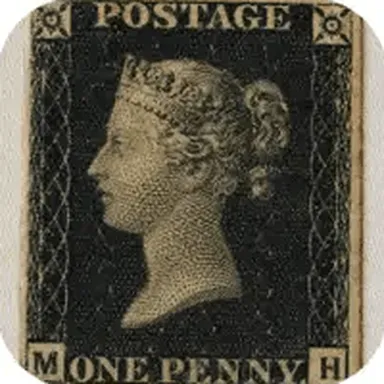
Conceived as part of Sir Rowland Hill's postal reforms, the stamp shows a profile of the young Queen Victoria engraved by Charles and Frederick Heath from an 1834 cameo by William Wyon. It was printed from 11 plates (Plate 1 was overhauled mid-run and is usually split into 1a and 1b). Because the red cancellation used on the black design was easy to remove and allowed stamps to be reused, the Penny Black was replaced in 1841 by the Penny Red, which took a more durable black cancellation. With tens of millions issued and roughly 1.3 million surviving, used examples are affordable and common; high prices are reserved for mint stamps, scarce plates (especially Plate 11), and covers.
How to tell if yours is the valuable one
- Confirm it is a Penny Black (1d, black, Queen Victoria profile), not the far more common Penny Red (1841 onward) — colour is the quick tell.
- Check the two lower corner letters (every stamp has a unique row/column letter pair) and look for a plate match; specialists plate stamps from the check letters and other markings.
- Margins drive value: four wide even margins are worth far more than a stamp cut into the design. The Penny Black has no perforations.
- A red Maltese Cross cancellation is normal; a black Maltese Cross is scarcer and worth more. Examine paper front and back for thins, tears, creases and repairs.
- For mint stamps, the original gum and the difference between Plate 1a and 1b materially change value — get a recognised expert certificate (e.g. RPSL, BPA) before buying or selling at the high end.
Quick identification tips
- Black stamp = Penny Black (1840-41). Red/brown stamp of the same Queen Victoria design = Penny Red (1841 onward) and very common.
- Plate 11 is the rarest Penny Black plate; most stamps are from far more common plates.
- Stamps still attached to their original cover or a piece of it are usually worth more than soaked-off singles.
Related stamps
- Inverted Jenny value — Extremely rare — only 100 ever existed.
- Blue Mauritius value — Among the rarest stamps in the world — only ~26-27 known.
See also our guide to what your stamp is worth and how stamp values really work.
Sources
Every figure on this page traces to a published reference or recorded sale: