
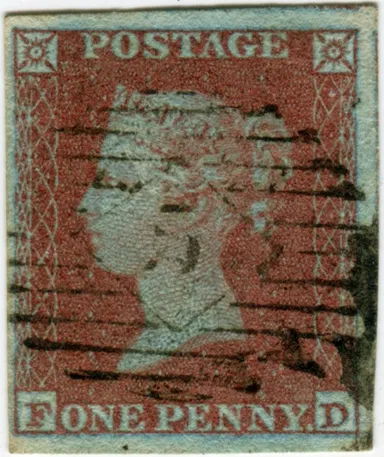
Estimated ranges from catalog & auction data — condition-dependent, not a professional appraisal. Treat every figure below as a starting point and confirm with a qualified expert before buying or selling.
Penny Red value: what it's worth
Value depends heavily on condition, so the figures below are given as ranges by tier rather than a single price. Very common — roughly 21 billion printed; most used examples are worth pennies.
| Condition | Estimated value |
|---|---|
| Used, perforated with plate numbers (1864-1879) — the typical Penny Red 10p-30p per Warwick & Warwick's Penny Red guide — the tier the vast majority of surviving Penny Reds fall into. Scott guidance: heavily cancelled, poorly centred copies sell for 10-20% of catalogue value. | £0.10 – £0.30 |
| Used, perforated 'stars' (1850-1855, letters in lower corners only) 30p-£10 in collectible used condition per Warwick & Warwick. Value rises with clear cancels, good centring and scarcer perforation/watermark combinations. | £0.30 – £10 |
| Used, imperforate red-brown (1841-1854) 50p-£5 in good used condition per Warwick & Warwick. As with the Penny Black, four clear margins command the premium; cut-into examples sit at the bottom of the range. Mint examples with original gum are far scarcer and worth a specialist valuation. | £0.50 – £5 |
| Plate 77 — the famous rarity (a handful of examples known) The two recorded modern sales: £550,000 in 2012 (reported record for a single British stamp, buyer in Australia) and £495,000 at Stanley Gibbons, March 2016 (one of only ~5 known used examples). Not a market 'range' — each sale is its own event. | £495,000 – £550,000 |
Values last checked: July 4, 2026.
Record / notable sale £550,000 for a used Plate 77 example (2012, reported as the record for a single British stamp); another of the ~5 known used Plate 77s sold for £495,000 in March 2016 — 2012 (private sale); March 2016 (Stanley Gibbons), Stanley Gibbons, London (2016); the 2012 sale was reported by the philatelic trade press.
Rarity & how many exist
Very common — roughly 21 billion printed; most used examples are worth pennies.
- Print run: About 21 billion printed by Perkins, Bacon & Co over 38 years (1841-1879)
- Surviving examples: Enormous numbers survive — the Penny Red is one of the most common classic stamps in existence
Catalog numbers
- Scott: Scott 3 (1841 imperforate) and Scott 33 (1864 plate numbers)
- Stanley Gibbons: Stanley Gibbons 8-12 (1841 imperforate), SG 17 onward ('stars'), SG 43/44 (plate numbers)
- Colnect: Colnect: Great Britain 1841-1879 Queen Victoria 1d red
History
The Penny Red took over from the Penny Black in February 1841 because a black cancellation on a red stamp was far harder to remove and reuse than a red cancel on a black stamp. It was printed imperforate until perforation was adopted in the 1850s (gauge 16, then 14 from 1855), with small-crown then large-crown watermarks; from 1864 the corner stars were replaced by check letters in all four corners and the plate number was woven into the engine-turned design. More than 400 plates printed roughly 21 billion stamps before the Penny Venetian Red replaced it at the end of 1879. Plate 77 (1863) was rejected for poor alignment and its stamps were never meant to be sold — a handful escaped, and those few stamps are among the most valuable in British philately, while the other 21 billion Penny Reds remain resolutely affordable.
How to tell if yours is the valuable one
- Red/red-brown stamp of the Queen Victoria profile design = Penny Red (1841-79), the common successor to the black 1840-41 Penny Black. Colour is the quick tell.
- From 1864 the plate number (71-225) is hidden in the engine-turned network at the left and right of the design — read it with a magnifier. Nearly every plate is common; the lottery ticket is Plate 77.
- Beware altered stamps: forgers shave or repaint plate numbers (e.g. turning 177 into 77). Any claimed Plate 77 must have a certificate from a recognised expert body (RPSL, BPA) — only around five used examples are known.
- For pre-1864 stamps, variety (and value) is set by perforation (imperf, gauge 16, gauge 14), watermark (small vs large crown) and the corner check letters — a specialist catalogue is needed to place them precisely.
- Condition rules the price at every tier: margins on imperforates, centring and cancellation clarity on perforated issues, and original gum on mint examples.
Quick identification tips
- Stars in the top corners + letters only in the bottom corners = 1841-1864 issues. Letters in ALL four corners + a plate number in the side ornament = 1864-79 plate-number issue.
- No perforations at all = the earlier 1841-54 printings (or a trimmed later stamp — check the design edges).
- A Penny Red on its original envelope or letter, or with an unusual cancellation, can be worth more than the stamp alone — don't soak stamps off covers.
Related stamps
- Penny Black value — Common — tens of millions issued, over a million survive.
- British Guiana 1c value — Unique — only one example known to exist.
- Inverted Jenny value — Extremely rare — only 100 ever existed.
See also our guide to what your stamp is worth and how stamp values really work.
Sources
Every figure on this page traces to a published reference or recorded sale: